Wednesday, September 16, 2015

de Mingle, A Homey Indo-Dutch Bistro

While this cozy spot isn't located in the busiest hub in Jakarta, but de Mingle has just enough crowd to present a vibrant yet homey ambiance. Staying true to its name, we feel that people do come there to mingle and delicious dishes.

Honestly, if it's not because of Dilmah High Tea Challenge Restaurant & Cafe, we probably would never step into this place and regretting it for the rest of our blogging lives.This is Ruth's story (as Fiona called in sick for the day) with MJ, another food blogger in our office who helped with the pictures. 

Front Door. Photo by MJ
Window sating is our favorite spot. Photo by MJ
de Mingle Indo-Dutch Bistro is Located on the corner of Graha Handaya office area, a short drive from Siloam Hospital Kebon Jeruk. Stepping inside, we're liking the mood right away. The friendly waitress seated us on the perfect table on the corner. The food will arrive shortly, she said. Then the bistro owner, Shirley, came to chat and sit with us.

First floor seating
Cashier area
She runs de Mingle with a few friends. "It just happens that the grandmas are still Holland sprechen so we decided to create a Dutch restaurant," she said. Indeed the food listed on the menu bears the name like Moeder Subiyarti Rijsttafel or Moeder Mirani Rijsttafel. The other main courses are also typically Dutch, something considered nostalgic for the older crowd but with flavor that would fit today's generation tongue. Shirley recommends Biefstuk or Dutch Sirloin Steak (Rp132k) or Galantine (Rp79k), a grandma's recipe of beef mixed with egg and herbs.

A surprise from the house, Huzaren Sla arrived on our table. Lettuce, carrot, bean, pineapple, apple, beef, cucumber with homemade Dutch sauce (Rp53k). Egg yolk gives a bright yellow color to the dressing. Fresh from the first bite, you can easilly say that if there's love at first bite, then we'd go try all the food in de Mingle if they're as good as the salad. The next one to arrive is Kalfstong Biefstuk (Dutch Ox Tongue Steak, Rp69k), grilled after marinated with herbs and wine. Another must-try is Franz (Rp69k), roasted boneless chicken breast with thyme flavor, accompanied by sauteed mushroom and olive oil sauce. On the side is boiled potato. Both dishes have a homey, grandma's recipe taste to it. 

Huzaren Sla and Kalfstong Biefstuk
Franz is roasted boneless chicken breast with thyme flavor
But we're there for Dilmah High Tea Challenge Restaurant & Cafe and the dishes are here on the table. On the High Tea Menu are:

Exotic Tea Spa: Lemongrass Cinnamon Hot Tea paired with Apple Crumble
Heritage Tea Spa: Summer in Green Ice Tea paired with Fish Finger
Classic Tea Spa: Peppermint Tung Tung with Black Tea Kelepon
Exotic Tea Spa: Lemongrass Cinnamon Hot Tea paired with Apple Crumble
Heritage Tea Spa: Summer in Green Ice Tea paired with Fish Finger
Classic Tea Spa: Peppermint Tung Tung with Black Tea Kelepon
Wait... Kelepon? Yeah, you heard that right. Black Tea Kelepon served with Peppermint Tung Tung is one unique combination. While they sit on the opposite end of the plate, it's nice to combine them together and have the tung tung (that's rough-textured ice cream made of coconut milk instead of milk) melts inside your mouth as you chew on the kelepon. Apple Crumble is beyond description. Scrumptious? Heavenly? And the hint of Lemongrass Cinnamon Tea gives balance to the pair. Summer in Green Ice Tea is peppermint, Chinese cabbage and pineapple. A refreshing tea twist of the Evergreen from the fresh juice selection.

The two-story bistro reserves its second floor for events and smoking area. Larger crowd can also sit upstairs with comfortable sofa and lively ambiance. "We have a lot of gatherings here, some are the medical doctors from hospital next door," Shirley said. As far as event goes, anything from talk show to Sweet Seventeen or even marriage proposal is possible.
Second floor seating. Photo by MJ
When you stay and mingle, times goes by slow. It's hard to leave our seat but as lunch time ticking its last minutes, we said our goodbye to this comfortable restaurant. We will return.

Where is this?
Jl. Raya Pejuangan Kav.12A Unit C, 

Graha Handaya, Jakarta Barat 12270
(021) 53660431
www.demingle.com/

Tuesday, September 15, 2015

Noizu Toku Toku Unique Ice Cream Mix

You usually meet your ice cream already pre-made, lining up in different flavors ready to be mixed with toppings and served. But Noizu Toku Toku is making them fresh to order in front of you. Wanna try?


Our delightful lunch journey brought us to West Jakarta, at an ice cream corner called Noizu Toku Toku at Mal Puri Indah. Located right outside the West lobby, facing the extension, this handmade dessert is offering a wide range of flavors and toppings. Practically endless creation. So, where do you start? Monica from Noizu Toku Toku suggests one of the popular creations: Karameru Koranchi (Rp42k). Caramel ice cream mixed with dark chocolate and crunchy granola toppings. We agreed right away. And this is where it gets interesting.

Instead of scooping the ice cream from a tin, the ice cream maker poured a thick milk-shake like liquid on the ice pan (up to -10 or -20 Celcius). He then started stirring and chopping the slowly crystalized ice cream until it turns creamy. Setting that aside, he started again with the melted chocolate mixture. 


Final result: Karameru Koranchi 
"You get more texture with this kind of process instead of the usual pre-made ice cream," Monica explained. An Asian concept (wiki said this ice grill technique is commonly found in Thailand), Noizu Toku Toku adapt it into local invention with house made recipes.

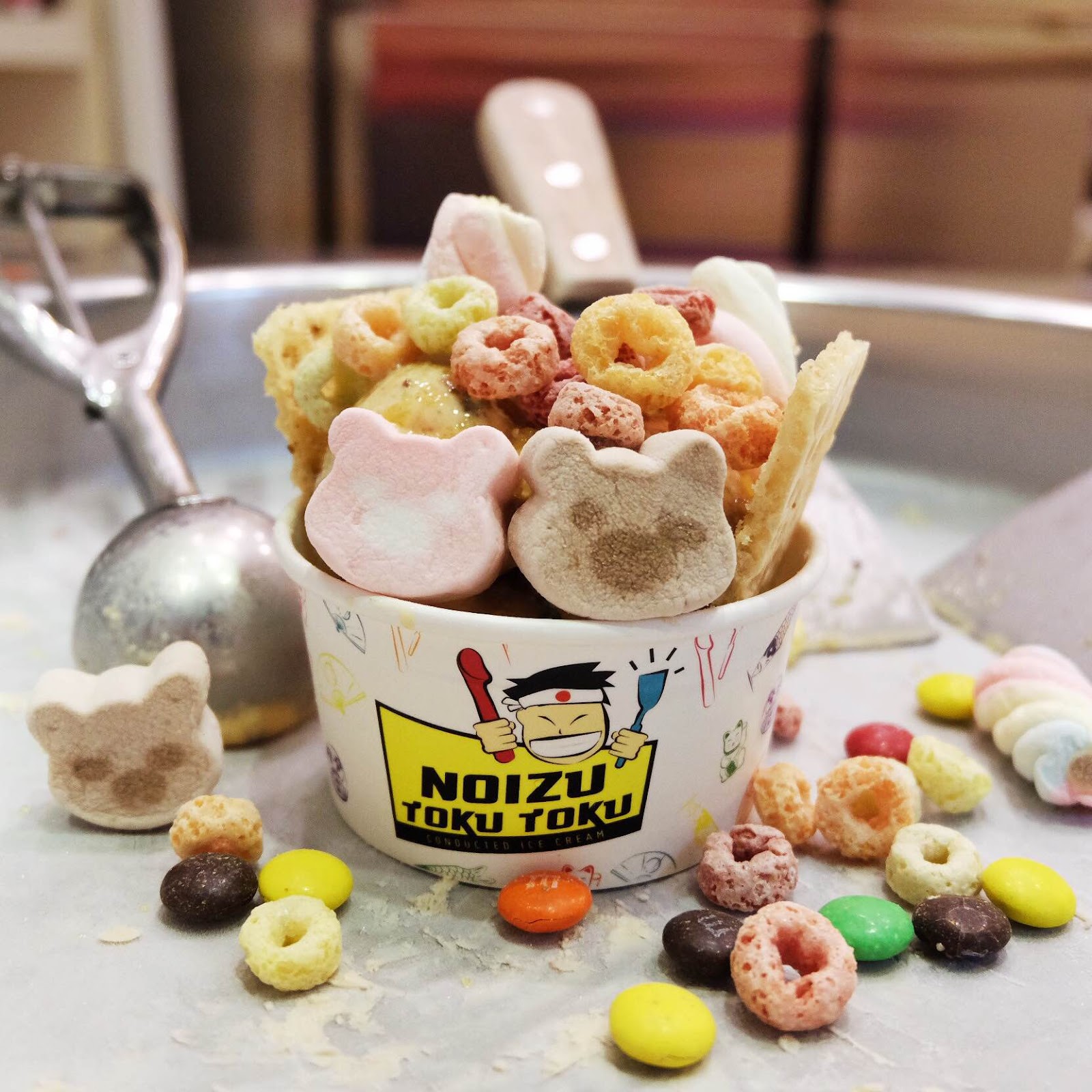
We're about to pick the second bowl to share and were torn between Kraffelicious and Cafe Brownie. But Monica mentioned that younger customers love to innovate their own ice cream. So, we ended up taking the challenge. Plain is more to vanilla. Avocado is unique. What we have in mind is a sweet and bright concept called "Candyland," so we ordered another caramel ice cream (Rp33k) and added marshmallow jellies (Rp4k), marshmallow teddy bear (Rp4k), fruit loops (Rp4k), M&M Choco (Rp5k) and Popping Candy (Rp5k). Surprise!


Welcome to Candyland
But once these ice cream are on your hands, eat them quick because the change of temperature will melt them quicker than the regular ice cream.

As you have probably guessed, the name "Noizu Toku Toku" comes from the noise heard when the spatula chopped the ice cream and bumping into the ice pan, as well as the bumping noise when the ice cream is thrown down to the ice pan. It takes a couple minutes to have them ready, but we enjoy every second as we watch the mixture solidify into the dessert we know. 


If you're creating your own, use this "cooking" time to pick your toppings which is varied from cheese cheddar, almond flakes and Loackers to fruits and jelly. If you're a cereal fan, Koko Krunch and Fruit Loops are there to accompany your "breakfast". Extra sauces (chocolate, strawberry, caramel and salted caramel - each Rp3k) are recommended for those wanting extra kick. Waffle cups and cones (Rp5k) are nice to have because after all, the ice cream we're familiar with is served on edible cones.

It's like being involved in a science project with a sweet edible ending.

Where is this?
Noizu Toku Toku
Puri Indah Mall, Lantai Ground, 

Jl. Puri Indah Raya, Puri Indah, Jakarta

Tuesday, September 8, 2015

Kalimantan Flavors at Kempinski Jakarta

The first thing that comes to mind upon hearing the word "Kalimantan" is the myriad of tropical rainforests with animals and plants we probably won't find in any other parts of the world. In a place like that, imagine what food is going to be like. In the end of August, Lunch Getaway took a two hour escape from the hustle and bustle of Jakarta to step into the recreation of magical Kalimantan at Hotel Indonesia Kempinski, Jakarta.


Kempinski brought the whole island inside Signatures Restaurant as a part of a month-long Nusantara Food Festival. Going the extra mile, the hotel appointed a Kalimantan-based private chef to present authenticity. So, what are the taste, hidden under the vast beauty of Indonesia's largest island?

According to Chef Meliana Christianty, who helmed the Kalimantan team, it's indeed the nature. "Kalimantan food derived from the prosperity of its nature: the forest, the rivers, the sea, even down from the local backyards and village gardens. The tribes in Kalimantan are known for its ability to use what's growing around them, cooking them into something delicious," she explained.


Chef Meliana Christianty
Chef Meliana Christianty, the mastermind behind the cuisine

Kalimantan Dishes

Chef Meliana, who is based Pangkalan Bun, Kotawaringin Barat, Central Kalimantan, guided us through the food. One particular ingredient which kept popping up in different dishes is Cabe Habang, a dried red chili. Like the Bebek masak Habang (Caramelized Duck Cooked with Habang Chili) from Banjarmasin, South Kalimantan on the main course section or the Iga Sapi masak Habang (Ribs cooked with Habang Chili) on the carving station which mixes the spices, Habang Chili and Coconut Milk for the sauce. "Back in Kalimantan, we don't usually use ribs," said Chef Meliana. But the change doesn't seem to affect the delicious and juicy dish. 


Fiona expressed concern about consuming spicy dishes, but Chef Meliana said despite the color of Habang (Habang means red), it's not as spicy.

Different parts of Kalimantan are home to unique dishes, including the sambal. Take Sambal Raja Kutai from Kutai Kartanegara, East Kalimantan, for example. Or Dadah Belasan, Kahayan chili sauce with shrimp paste, a native to Dayak Kahayan tribe in Central Kalimantan. The Dadah is a mix of lemongrass and shrimp paste. Chef Meliana described this like "Crème brûlée ". The paste, a personal favorite of Chef Meliana, accompanies a satay dish served on a beef broth bowl filled with rice cakes called Sate Sapi Melayu Pontianak. Satay on a soup deserve an applause not only for the concept but also for the refreshing taste.


Sate Sapi Melayu Pontianak
served with beef broth and rice cakes cultets
"Different tribe means different flavors," Chef Meliana said. It's because they are using different spices and ingredients for their dishes. "The most common ones are Cabe Habang, Terung Asam Rimbang, Pucuk Pakis and Sayur Kelakai that grows in the swamp." Kelakai, like Pucuk pakis, is a vegetable from the fern family which is believed to have anti-aging effect. Terung Asam Rimbang (sour eggplant) is cooked with Tenggiri Asam Pedas (spicy and sour fish soup) at Signature, representing the West Kalimantan area. This dish is Ruth's favorite after Iwak Karing Batanak (Poached Duck Egg & Salted Fish in Savory Coconut milk of Banjar in South Kalimantan) because of the impression left after finishing a portion. It reminds you of a comfortable food you'd always want to have on your table. A tenggiri with an extra kick. 

Iwak Karing Batanak
(Poached Duck Egg & Salted Fish in Savory Coconut milk
of Banjar in South Kalimantan)
Fiona went on second serving with the squid despite being full. The Banjar Cumi Baubar (literally means grilled squid) probably puts a spell on her that she still mentions "squid" days after our visit to Signature. It's soft, not chewy with sweet spices that's not overwhelming. It's truly appreciated because with an Indonesian dish, spices can either be friends or enemies. 

Cumi Baubar (Grilled Squid) of Banjar Region
On the vegetable side: Teripang and Jamur Hioko Masak Jahe (Braised Sea Cucumber & Hioko Mushroom) and Tumis Mentimun (Sauteed Cucumber & Eggs) are both from West Kalimantan.

Soup is an acquired taste for us. Gangan Ubi Jukun, the Sweet Potato, Water Spinach, Smoked Fish & Kalimantan Jungle Eggplant Soup from Kutai, East Kalimantan, presents a foreign taste to our mouth. While the sweet potato and water spinach are everyday things for us, the broth takes you back to the Kalimantan Jungle. Don't really know how to describe this soup. Definitely need to give it a sip to complete your adventure. 

Out of curiousity, we asked Chef Meliana about what to bring home from Kalimantan. She pointed out Pepes Kepiting (Grilled Spicy Crab meat wrapped in Banana Leaves), a native to Balikpapan, in one of the pots. The rich spices mixture is often sold as food souvenir with Abon Kepiting (shredded beef with crab) from those returning from a trip to Kalimantan. We love the Pepes. It's flavorful and tempting to eat even without being accompanied by rice. 

Pepes Kepiting (Grilled Spicy Crab meat wrapped in Banana Leaves)
A culinary journey isn't complete without dessert. So our "field trip" ends with Sarang Burung Walet and Pisang Gapit, both are (lucky for us) not to sweet. Sarang Burung Walet (Bird's Nest), unlike it's name is a jelly-based dessert, often complemented by nata de coco and other fruits. While pisang gapit is a grilled banana. This time is served with Durian sauce.

Fiona: Isn't this jelly?
Ruth: Yes, it's jelly.
Fiona: Bird's nest?
Ruth: Jelly.

Pisang Gapit (left) with traditional Indonesian snacks
Es Sarang Burung (Bird's Nest)

Indonesian dessert table
We walk away from Signatures Restaurant at the end of out two-hour Friday break, feeling satisfied and happy that our short trip to Kalimantan introduced us to many things we can tell the world about Indonesian dishes. Special thanks to Hotel Indonesia Kempinski for the Borneo adventure.

Where is This?
Hotel Indonesia Kempinski Lobby Level
Jl. M.H. Thamrin no 1, Jakarta Pusat
(021) 23583898
http://www.kempinski.com
Twitter: @KempinskiJKT

Sunday, September 6, 2015

Smiling Faces at Sumire Yakitori House Singapore

The simple yet real friendly Yakitori restaurant called Sumire Yakitori House in Bugis has received a lot of praises from the local media. So on a chance to visit Singapore, we decided to give this local favorite a try. 

This is Ruth's adventure in Singapore.


My brother said it was good and he brought us to try Sumire Yakitori House. It's a great alternative to the usual food courts and kopitiams we usually frequented on our trip to Singapore. The restaurant is easy to find because it's on the same block with Bugis Junction. While it's listed as one of the mall's tenant, the entrance is outside and facing the street. As soon as we enter, we were pointed out a booth near the back. A convenient for us, who comes in a family of six. 


Despite all the menu placed on the table, advertising their lunch set and combos, there is an iPad for you to order. The process is quite simple, all you have to do is select the items you want to try and start placing them in the "cart". Similar to what you do when you're doing online shopping. You can also review the food, with enlarged pictures and description as you decide. Just don' forget to confirm your order, otherwise they won't arrive on your table.
Complimentary cabbage salad comes first. Then the enormous Bakudan Korokke (SGD8.90), a homemade potato croquette. It tastes like potato salad, hidden inside a large breaded and fried ball. Taste really yummy. You can actually order this and Yakitori if you want to skip the rice. 
Bakudan Korokke
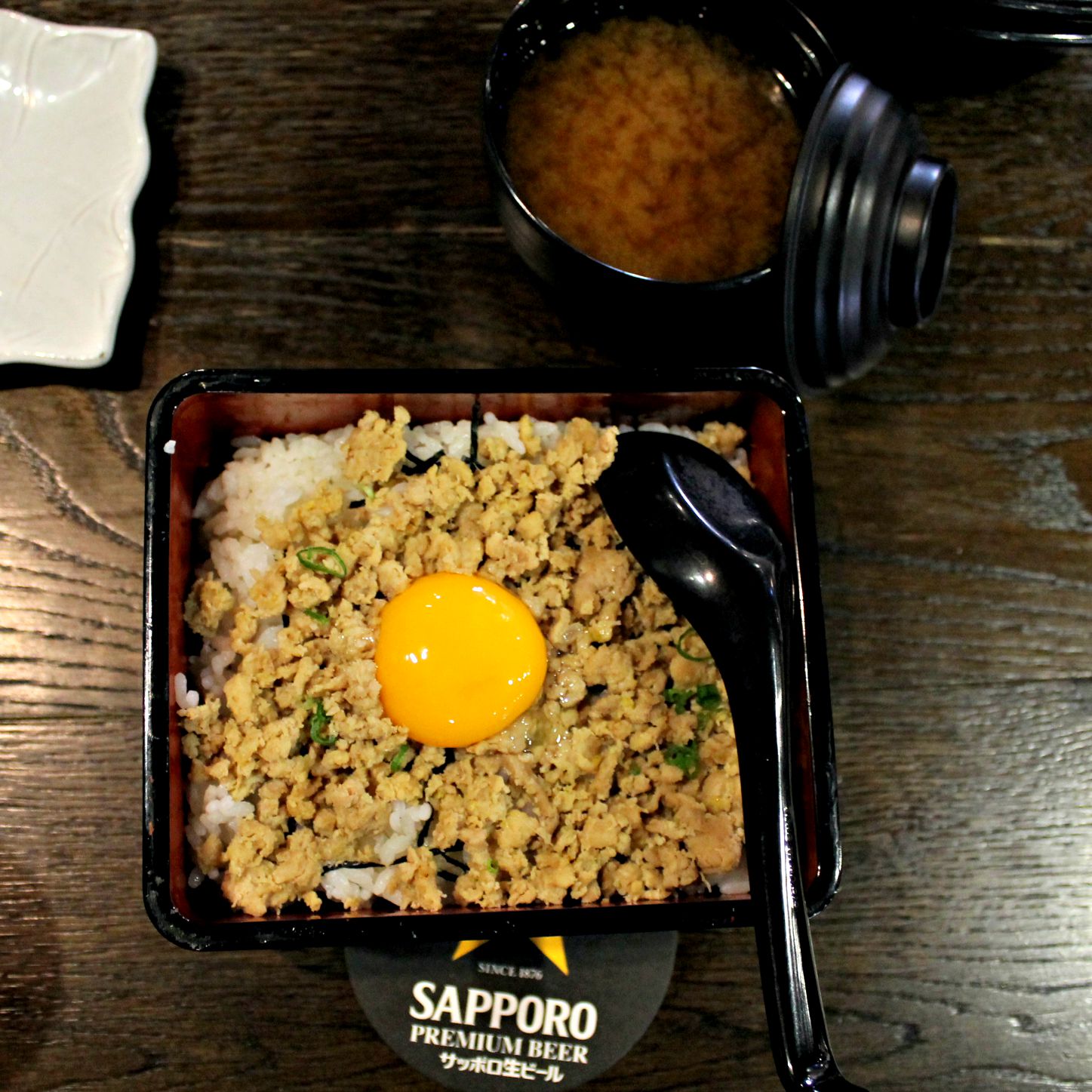
But I wouldn't recommend doing that because their Stamina Don is beyond delicious. The menu calls it "stir fry pork belly rice with homemade ginger sauce and raw egg yolk" (SGD9.90). I call it tasty thin-sliced pork over a warm rice. It needs to be mixed properly before you eat. But if pork isn't on your list, then Tori Soboro Don (chicken minced rice with poached egg, SGD9.90) should be on top of your list. 

Tori Soboro Don
Stamina Don
But the best thing about this place is the yakitori, better known as satay to those living in Southeast Asia. You can get technically everything on skewers here, from broccoli, asparagus and enoki to sushi, shishito and avocado. But we stayed away from the unique skewers and stayed on the meat side of the grill.

Left to Right: Pork belly with Oroshi Ponzu Sauce,
Bonjiri with salt and Momo with Teriyaki Sauce
Pork belly with Oroshi Ponzu Sauce (SGD3.20). Grated raddish with salty and sour sauce is placed on top of the pork. The ponzu sauce can be acquired taste for some. So if you're unsure, I'd suggest you'd go with the regular shio. Momo (chicken thigh meat) in teriyaki sauce and Bonjiri (chicken tail) in shio or salt are SGD2.90 each. They both taste great. Somewhat reminds you of a fancier version of the satay stall on the street. 

Just like the name, Sumire, the Japanese pronunciation of "smile", the food does bring smile to our face. So, we went home satisfied and it stays on until later that night. 

Where is this?
Sumire Yakitori House 
80 Middle Road #01-88/89 Singapore 188966
Tel: +65 6338 9963
http://www.sumire.com.sg/

Wednesday, September 2, 2015

A Mix of Surprises at Gran Mahakam

Believe it or not, this is our first visit to Gran Mahakam, a European style 5-star boutique hotel putting forward warmth and comfort of its guests. Yes, we’re here because of food too.


After saying hello to Debby Setiawaty, Director of Public Relations and Sheryll Angelina, Senior Public Relations Officer at the dining room with a big round table, we got a sneak peek of the food. The party started with an introduction of the hotel’s two restaurants: Le Gran Café and AOKI Japanese Cuisine. Le Gran Café serves International cuisines as well as time-honored Indonesian dishes which means there’s something for everyone. AOKI prides their authentic Japanese cuisine, refurbished to cater the earthy and natural palette.

“Blind Food Tasting” Mini Game

Hello, Fiona here, participating in this TV Show-like fun game.

Blindfolded, while tasting different food and trying to guess what’s on it. The first dish is served on a small bowl (or plate?) and is eaten by spoon. But once I smelled it, I know what it is because it’s my favorite Indonesian snack: Putu Mayang! The second dish feels like mayonnaise and nori. Sushi? I put it inside my mouth and the wasabi explodes. I’m not a big fan of wasabi, so I’m aware of its strong taste. The last one is sorbet because it’s cold and of sour flavor. After opening the blindfold, we’re asked to write the name and the ingredients of the three dishes served. Wish me luck!


Gado-gado Padang 
The Real Feast
Appetizers are Gado-gado Padang and Fresh Crab Hand Roll. The Gado-gado (Indonesian mix vegetable salad) is accompanied with super thick sauce and (surprised) yellow noodle. It reminds me of rujak juhi (without the juhi). I love this kind of Gado-gado. The roll is basically, crab meat wrapped in soy paper with fresh tuna on top. Soy paper instead of nori is a new challenge to everyone’s taste bud. Love this one too!


Fresh Crab Hand Roll
Soto Padang served as soup is irresistible. West Sumatra’s signature soup consists of angel hair, potato and jerked beef, topped with red crackers. Kudos to the amount of salt they’re using as well as the quality of the meat. Rice, anyone?

Soto Padang
Moving on to the main course, Nasi Daun Jeruk (Rice with Lime Leaves) comes with ayam masereh (shredded chicken with chili sauce), mixed vegetables with anchovies, squid with green chili sauce, jerked beef, satay, dried potato and our signature peanut brittle. This dish is arguably the most famous of Gran Mahakam and attracting loyal customers to return. People usually avoided young jack fruit in dishes but this one is good enough. But my vote goes to the squid; it’s so vibrant and tasty. 

Nasi Daun Jeruk (Rice with Lime Leaves)
Truffle Beef Bowl comes next. Japanese slices marinated beef sprinkled with the finest Truffle sauce and scallion served on steamed Japanese rice. The smell of Truffle is heavenly, the meat is soft and rice is moist. Another perfect dish. It’s gonna be hard to choose between the two main courses.

Truffle Beef Bowl 
Everything that starts out nice should end with a glam. So the two desserts better be unforgettable as well. Es Tape Hijau is a mix of tape ketan, tape singkong, kopyor, kolang kaling with milk, coconut milk and syrup. Tape is fermented dish, sometimes from cassava, others have them from rice or sticky rice. Ice shavings aren’t my thing but the fillings are tempting and I felt like digging up treasures. Mochi Ice cream, another Japanese touch on the feast. Japanese confection made from mocha (pounded sticky rice) with green tea ice cream filling. Yummy! Can we have more of them?

 Es Tape Hijau and Mochi Ice Cream
Last Surprise
Full stomach (after an array of great food) is always satisfying. So while we let that deliciousness down, the answers from previous games were revealed. The last one was raspberry sorbet. Whoa! Every participant jotted down different names and none of us were correct. The next surprise is me being named the winner of the game (really?). I just can’t believe it!

A big thanks to Gran Mahakam and Code Hunter for this Dolce Gusto Mini Me Machine, something I’ve been dreading to have this past year. Well, if you want this machine too, go download Code Hunter at the Appstore or Playstore. I’m not giving up mine. Ruth is gonna be jealous. 
Haha.

Where is This?
GRAN MAHAKAM HOTEL
Jl. Mahakam I No 6 Kebayoran Baru
Jakarta 12130 - INDONESIA
Tel : + 62 21 7209966
www.granmahakam.com